
Transport Weekly | Hasn’t adopted AI yet?

所属行业
客户规模
核心需求

In recent years, with the rapid development of technology, new terms such as big data analysis, artificial intelligence and blockchain have been pouring into the eyes of everyone. It seems that every concept can solve current issues and help us move into a beautiful new world. Taking artificial intelligence as an example, with the scope of AI application becoming more and more extensive, this concept is more and more often mentioned and has even become one of the “Top Ten Chinese Media in 2017”.

Many companies want to apply the latest technology to their management and operations, to ensure that the company does not fall behind. It’s the same for logistics industry. However, limited to the backwardness of informatization and digitalization in the logistics industry, new technologies such as artificial intelligence are often only used as a marketing tool. Suppliers may say they are using cutting-edge AI tech but in real word, the scope of application may still be limited to such small things as Optical Character Recognition (OCR).

Two key factors are required to truly achieve industry innovation through new technologies.
First, change manual operations to achieve supply chain digitization. Data is the basis for all innovation in the information age. If the data is still scattered and remains offline, there is no use talking about optimization through big data analysis and AI. Second, open attitude and unremitting efforts are required from management level. To change the existing offline process is not an easy task. People are always accustomed to familiar operation methods, and often have instinctive rejection of new things. This requires business leaders to have enough determination and skills to promote the popularization of new technologies through various efforts.

In this way, break-through technologies like AI can avoid being turned into empty talk and really landed to serve the transportation industry.
Transport Weekly | Veteran’s 5 step guide to sucessful transport procurement

所属行业
客户规模
核心需求

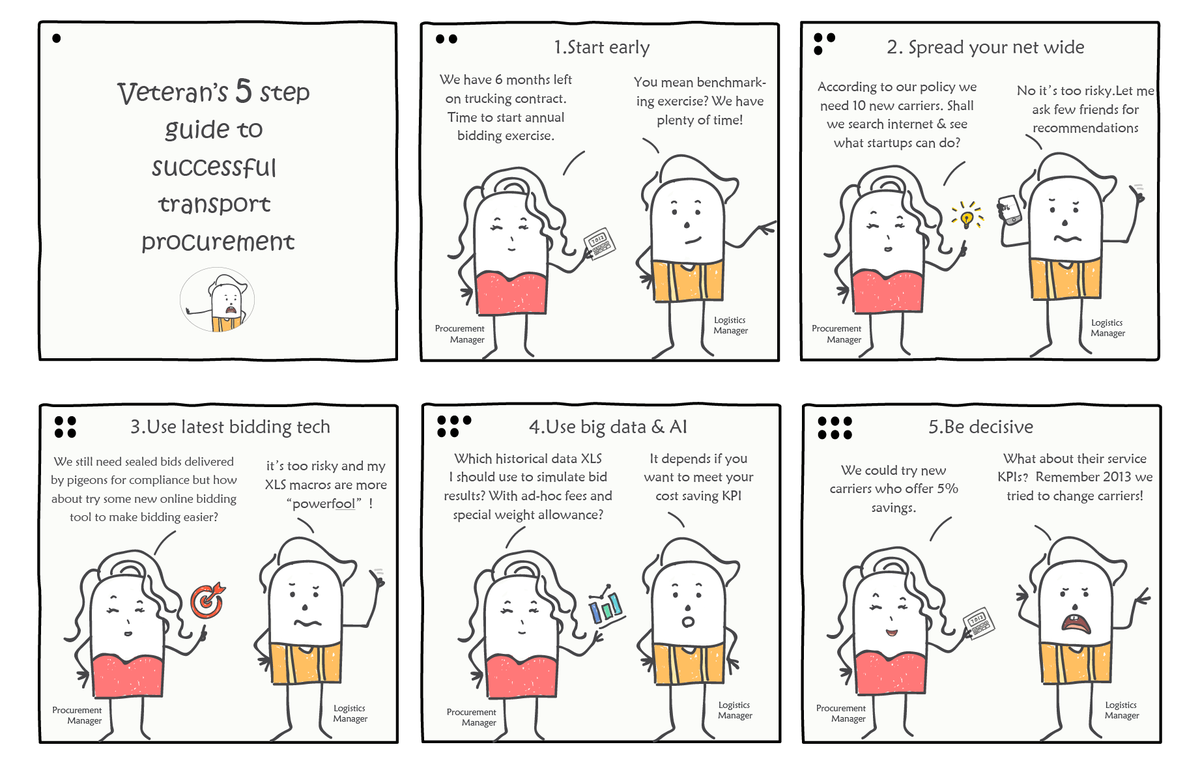
Many procurement and transport professionals struggle with developing and maintaining competitive carrier mix that can serve their fast-evolving delivery needs, especially in the market like China. Traditionally many manufacturers and retailers relied on small number of trusted logistics providers to outsource their whole transport, who worked on exclusive de-facto multi-year contracts in exchange for the convenience.

In such circumstances annual, lengthy procurement process with phases of sourcing, screening, bidding, analysis and final negotiation of rates served largely as benchmarking exercise to meet corporate policy and savings targets. These targets were often achieved only in theory, with complex XLS simulations showing potential savings while in practice cost often remained same or increased through monthly billing with various ad-hoc fees in another set of unrelated XLS. Logistics and procurement could fool each other into believing targets are met.

Things have changed, for several reasons. E-commerce and new retail push shippers to adopt faster and often more expensive delivery channels, as order sizes are decreasing while geographical coverage and frequency increases. China parcel delivery segment is developing fast with very competitive service offerings from both established and new players (like o2o/food delivery) emerging every day. In such situation using fixed trucking and 3PL companies on lengthy annual contracts is simply a negligence and leaving lot of money on the table, especially as shippers face declining growth rates and intense price competition. Trucking market is also evolving fast, with many new entrants eager to subsidize the business growth on one hand and raising trucking/driver costs on the other.

Tools like oTMS and Freight Partner reduce the risk to try new carriers and increase the ease and convenience of such change – by higher end to end transparency of both cost and service levels. When you source new carriers you can check their track record on oTMS with similar shippers, you can access some of their public rates, you can run “what-if” cost simulation and you can run actual bidding where the winning rates can become automatically rates used for actual billing and payment.

Most importantly, through technology though you can adopt some of the best practices of dynamic carrier pool management and switch the volume between carriers depending on actual service levels, actual cost and dynamic discounts offered by carriers, without a need of running a costly & risky annual RFQ (Request for Quotation). RFQ on Freight Partner is used to source and qualify sufficient number of carriers to use your pool and to set maximum cost budgets in compliance with your compliance policies. Transport is a service industry and it can’t be simply procured on the rate alone, let carriers service speak for themselves – which can only be achieved by deploying technology like oTMS to generate real execution data as a basis for management decisions incl. carrier business allocation.

Transport Weekly | Manual work – original cause of complex Freight Audit & Payment

所属行业
客户规模
核心需求

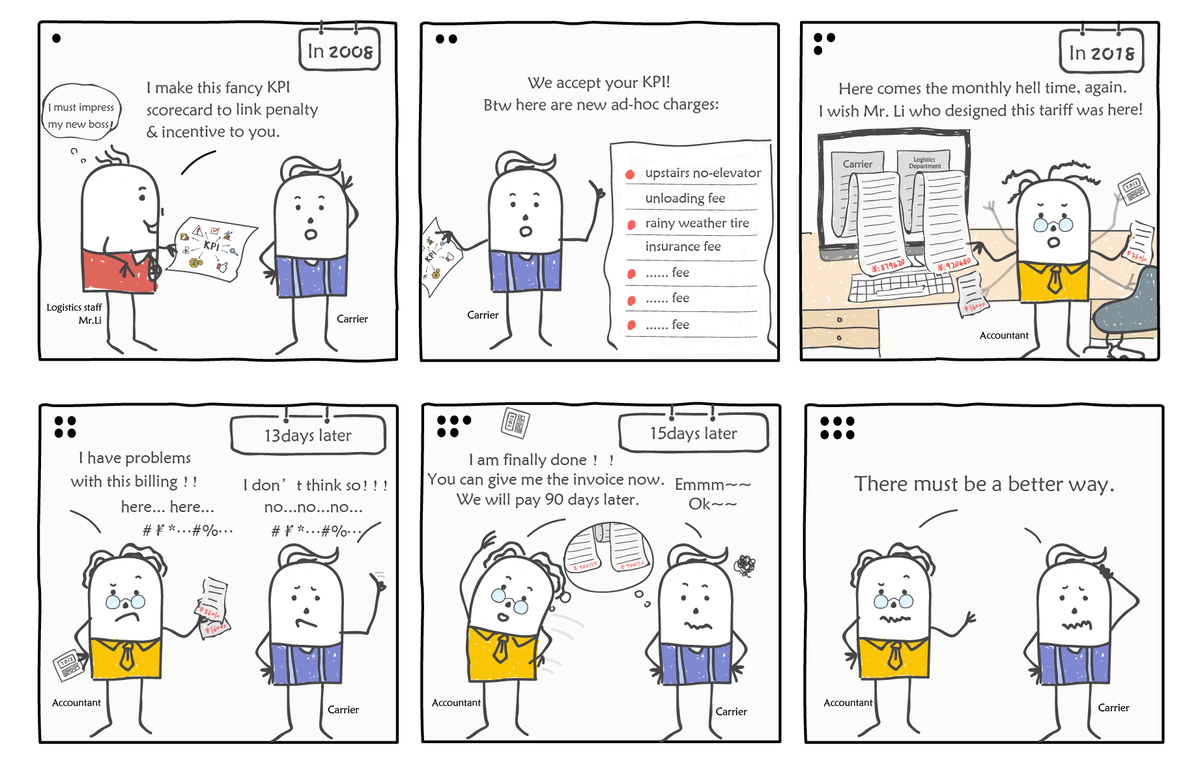
Trucking companies in China face notoriously long payment cycles that forces them to maintain heavy capital reserves to support the business. Drivers need to paid virtually daily while most big shippers pay within 60-120 days from the date of official invoice (fapiao) issue. But that is only part of the problem, it also may take another 30-60 days to actually confirm pro-forma billing.

This process requires carrier and shipper to prepare, review and negotiate long list of shipments that includes complicated charging mechanisms, special ad-hoc charges, review exceptions, apply penalties & compensation for damaged/missing goods etc. The process is time and labor consuming and inevitably leads to errors that are hard to detect, especially for senior managers that don’t have capacity to check all details. Globally it is estimated that billing inaccuracy in transport can be as much as 8 % (source Wikipedia: https://en.wikipedia.org/wiki/Freight_audit)

Traditional solutions involve FAP – Freight Audit & Payment that is often applied post-fact and involves costly 3rd party services, often manual in themselves. The root cause is often legacy tariff and billing process that is highly manual and difficult to automate. XLS spreadsheet are flexible to design any fee structure and notorious for having often a long list of “remarks” and mechanisms that may look good when introduced during for example bidding or operation process but are often very difficult to execute consistently in practice.

Take for example already much more transparent and standardized ocean/air freight charge mechanism: do we apply minimum fee before or after volumetric conversion? Do we apply various surcharges like BAF, CAF, FAF separately to base freight or in certain sequence? The list and possible variations go on and on. Now imagine that challenge in trucking where nothing is standardized.

So can there be a better way? Yes. oTMS designed reciprocal tariff and billing ensures full integrity and automation of this process and it can even start from transport procurement – online RFQ to ensure no errors are made, any ad-hoc charges are transparent and process can finish within 1 day saving considerable cost and effort. Having good system in place and ability to model transport cost based on different tariff structure can help to control cost within expected range, something that is not possible or trackable for as long as XLS based process exist.