Transportation and Logistics Industry – Year End Recap and Outlook

所属行业
客户规模
核心需求

2022 is still a year in which the transportation and logistics industry faces many challenges and unknowns. With the New Year approaching, we will take you to review what impacting events have occurred in the transportation and logistics industry this year, as well as the outlook for the industry from the global business consulting agency FTI Consulting.

1. Impact of E-commerce Growth

With the omnichannel approach to e-commerce retail gaining ground, it has become imperative for logistics providers to adopt automation and newer technologies such as AI, geo-fencing, IoT, and data analytics to make the delivery and returns experience seamless and cost-effective for both customers and retailers. Rising adoption of analytics-powered dynamic route planning systems is facilitating logistics companies in optimizing operations and providing cost-effective and seamless experience to both customers and retailers.

2. Impact of Russia’s Assault on Ukraine and Covid-19

The conflict has disrupted the supply of key raw materials. Freight has been re-routed, derailed, and suspended from surrounding areas disrupting the global supply chain network.

Despite the threat of the Omicron variant, the near-term outlook for the global economy is positive. global supply chain is recovering in an orderly manner, international trade is growing, especially in Europe, America, and the Asia-Pacific region, and the global economic recovery is expected to accelerate in the next 2-3 years. However, with the demand for logistics services growing and the pandemic-led labor shortage, there is increasing pressure on the supply of labor, particularly in the trucking industry, which is facing a major shortage of drivers.

3. High Freight Cost

Shortage of shipping containers is emerging as a serious concern as the demand for Asian exports increased strongly, filling all available vessel capacity and leaving equipment stranded in the U.S. and EU. Port congestion, particularly along the U.S. West Coast, has turned out to be a major issue for shipping companies, as ships now must wait longer to get unloaded, which results in higher costs.

4. ESG Risk Framework

Amid mounting pressure from customers, employees, regulators, and investors, T&L providers are prioritizing the adoption of more sustainable processes to align with evolving market realities and to gain competitive edge, however, there are only few companies that have internalized these processes.

5. Workforce Diversity

Workforce diversity within the Transportation & Logistics (T&L) industry lags significantly, when compared with other industries; hence, industry players (such as DHL, Maersk, and XPO Logistics) are prioritizing the adoption of policies that ensure diversity and inclusion within their workforce.

Global Logistics Market Outlook

The global logistics market is expected to grow at a 6.8% CAGR during 2022-2030, particularly due to surge in e-commerce logistics, containers shortages, closure of major ports causing port congestion, shortage of truck drivers, andrestricted capacity in the air freight market. APAC will be the largest logistics market globally, holding ~45% of the total market share, and is expected to outperform other regions in the future due to positive outlook for emerging economies in the region. Asia is expected to contribute ~50% of global trade growth by 2030.

As the Asia-Pacific region gradually keeps up with the digitalization process in North America, the popularity of the Transport Management System is continuously growing. More and more enterprises are using TMS to manage their transportation network. Therefore, as a pioneer of transportation management platform, oTMS launched international version of TMS, and Singapore entity established in 2022 to help enterprises in the Asia-Pacific region to accelerate the digitalization of their local and international logistics and transportation management systems, effectively supporting the continuous growth of their business in the Asia-Pacific region.

Through the oTMS transport management system, enterprises can manage orders and shipment, connect shippers, carriers, 3PLs, drivers and consignees on a single, automated end-to-end shipment workflow, improve shipment visibility for internal and external parties leading to a better customer service experience and brand value creation. Enterprises can also manage freight cost with accurate, automated system billing and cost allocation that also reduces time and workload of monthly reconciliation.
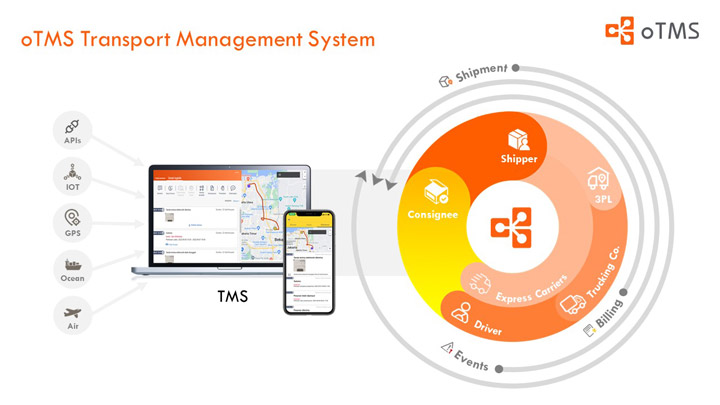
Many large and medium-sized enterprises have chosen oTMS to manage their daily transportation execution, covering multiple industries such as retail, automobile, industrial manufacturing, fashion, medicine, and logistics, and the cumulative volume of processed orders exceeds 500 million.

Sources: Transportation and Logistics Industry – Year End Recap; FTI Consulting
Case Study | How did the leading grain enterprise achieve integrated management of transportation data?

所属行业
客户规模
核心需求

Although all industries have entered the stage of informatization and digitization, the technical and management capabilities of enterprises are uneven. As far as transportation is concerned, highly integrated transportation management can bring higher efficiency and further widen the gap with competitors, especially for grain enterprises. The real-time transparency of “order-transportation-ledger management” process, integrated interaction and reasonable planning have a far-reaching impact on the level of digital development of enterprises. Today, we will share with you a case of data integration management in the entire transportation process of a leading enterprise in the grain industry.

Client Introduction

As a leader in the grain industry, it specialized in processing, trade and sales of rice, wheat and brewing materials. Its business layout covers major grain production regions in China, grasping first-hand grain resources at home and abroad. With branded sales network spreading across the country, all its business units have established an industry-leading position. In addition, it is also a forerunner of digital transformation, and has implemented systems such as SAP, OA, and all-purpose card earlier.

However, under the management mode of those systems, there are still many problems such as isolated information and loose management due to complicated channels. The client hopes to solve the above pain points through the oTMS solution and complete the integrated management of the data in the entire transportation process.

oTMS Solution

> Key Highlights: 

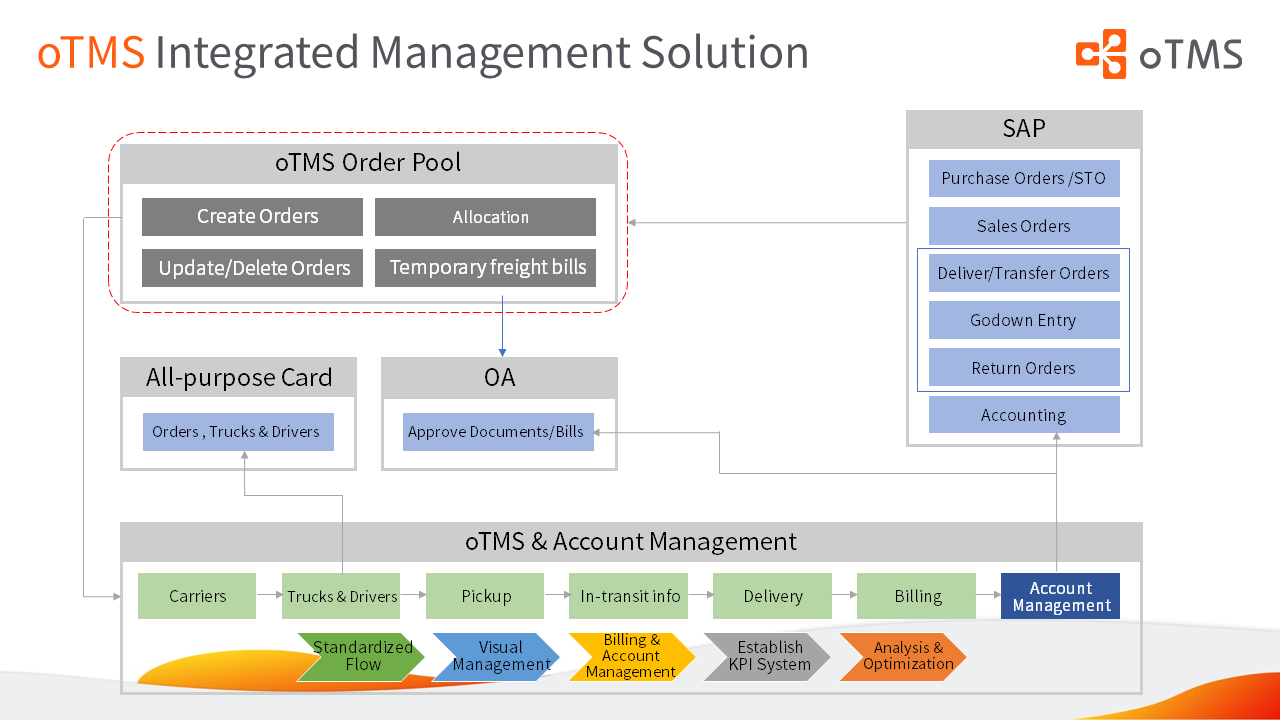
1. Connect information systems such as SAP, OA and all-purpose card with the oTMS transport management system through middleware to realize data interaction and process control;

2. Real-time management and control of logistics-related document flow, business flow and financial flow;

3. Real-time tracking of cargo information through mobile APP, WeChat mini program and WEB interface application on multiple platforms.

 > Project achievements: 

Through the integrated management solution of oTMS, all kinds of documents generated by client using SAP will be transferred to the oTMS order pool; then, the orders will be synchronized to the oTMS transport management system for the allocation of carriers and drivers, and the in-transit information of pickup, in-transit and delivery will be real-time visual, the information of order, truck and driver will also be synchronized to the all-purpose card, providing data support for the construction of the carrier’s KPI system; transportation documents and bills are approved and processed by the OA system, forming a closed management loop of “order-transportation-ledger” . Since the project was launched in 2020, more than 40 factories have been implemented, and the cumulative number of shipments has exceeded 370,000.

In the environment where digital transformation has become an industry consensus, how to improve technology and management capabilities is the top priority to ensure the overall revenue growth, efficiency improvement and cost reduction of enterprises. oTMS combines market trends and actual customer management pain points to build advanced transport management system. On the basis of the management system, oTMS further opens up the data interaction of various systems, realizes integrated management and cargo tracking, and helps customers to promote business activities with low cost and high efficiency. In the future, oTMS will also continue the spirit of innovation, continue to improve technology and services, provide customers with valuable logistics and transportation solutions, and make transport more smart.

Is in-house TMS development better than outsourcing?

所属行业
客户规模
核心需求

Nowadays, the digital transformation of enterprises has become a market consensus, and technological capability is one of the most important productivities for enterprise development, especially in the logistics and transportation industry, enterprises attach great importance to the use of digital tools: starting from the earliest use of ERP, and extending to specialties management like TMS. According to the studies of Allied Market Research, almost 35% of the enterprises worldwide are now using TMS for managing their transportation network. With increasing complexities of logistics and transportation, the need for TMS can never be exaggerated.


The ultimate aim of digital transformation is to improve technology and management capabilities, and to achieve overall revenue growth, efficiency improvement as well as cost reduction. Therefore, the method and intensity of investment in digitalization is an important subject that every decision-maker must study. We will talk about these topics in this article: Which one is better, self-developed TMS or outsourced? How to input resources more efficiently?

1. Build a cost structure model from a global perspective

To get the answers to these questions, the decision-makers must deepen their understanding of the nature, composition, and classification of enterprise technology costs. Enterprises need to establish a cost structure model from a global perspective and form business-oriented cost metrics, so as to ensure that cost input can achieve the ultimate aim of digital transformation. 

The enterprise technology costs include not only the cost of the technology department, but also the cost of the enterprise’s business department to develop its business through technological capabilities. They could be divided into 2 dimensions, one is explicit cost, which is directly related to technology departments: IT resource cost, labor cost, data cost and cost of funds; the other is implicit cost, which is related to enterprise business: time cost, opportunity cost, trial-and-error cost and sunk cost.

· IT resource cost: The facility cost used by enterprise to support the construction, operation and maintenance of IT systems.

· Labor cost: The human resource cost invested by enterprise around the construction, operation and maintenance of the IT system.

· Data cost: The cost of data collection, analysis and usage by enterprise.

· Cost of funds: The cost paid by enterprise to raise and use funds.

· Opportunity cost: An enterprise uses certain resources to produce one commodity, but loses the cost of using these resources to produce other commodities of the highest value.

· Time cost: The cost of time used by enterprise to engage in an activity.

· Trial-and-error cost: All the costs incurred by enterprise in the process of constantly trying different methods to solve a problem.

· Sunk cost: Costs that have been incurred by enterprise and cannot be recovered.

2. Do not invest strategic resources in non-strategic directions

For enterprises, decision-makers should focus on the key “efficiency factors” such as how to optimize time costs and how to reduce trial-and-error costs, so that they can go straight to “doing the right thing” instead of “doing it in the right way”.

Therefore, the pioneering enterprises in the digital transformation have given the answer between “in-house TMS” and “outsourced TMS”, and they have become top students in digital transformation by choosing outsourced TMS. Now, they have shifted to a more far-reaching strategic stage – refined management.

More and more cloud-based transportation management systems are sold as software-as-a-service (SaaS) due to this trend. This means that users subscribe to the technology on a monthly or annual basis. This is more cost-effective and users are always on the most recent version of the software, which provides opportunities for the overall growth of the market as well.

3. How to input resources to generate income or gain profits

As a pioneer of transport management platform in China, oTMS has won the favor and recognition of many benchmarking companies with its interconnected TMS since its establishment. The pioneering SaaS TMS+APP/mini program+API+IOT model allows enterprises to easily realize the digital management of the whole process and all channels of transportation through oTMS, covering road, express, and multimodal transportation. From order distribution, real-time transport visibility for road, express, air and ocean to digital POD, data analysis, and dock scheduling, the overall logistics management and control capabilities of enterprises have been greatly improved by using the oTMS system.

In this process of digital transformation, the investment of enterprises has been transformed into tangible efficiency improvements and cost reductions. For example, a well-known fast fashion retailer with 7000+ outlets around the world, whose orders are about 1 million/month, eliminated 500,000 pcs of paper through oTMS APP QR Code scanning by POS, achieved paperless store deliveries / returns / transfers. The biggest food company in China with 130 factories and distribution centers achieved 6.7% cost saving of freight cost in first 6 months through advanced ship-from location optimization based on inventory and production schedule. A leading auto parts company with 3000 shipments/month achieved nearly 1.5% cost saving through auto order consolidation and allocation.

In an complex environment, TMS is an important foundation for enterprises to move towards refined and intensive management. Especially for large enterprises with multinational business, increasing the digital transformation of logistics can accumulate more power to improve comprehensive competitiveness. Choosing a professional service provider allows enterprises to focus their energy and resources on the most strategic and core business. As a pioneer in the TMS industry, oTMS will always break through itself, and use advanced technology and perfect products to continuously serve the business of enterprises.