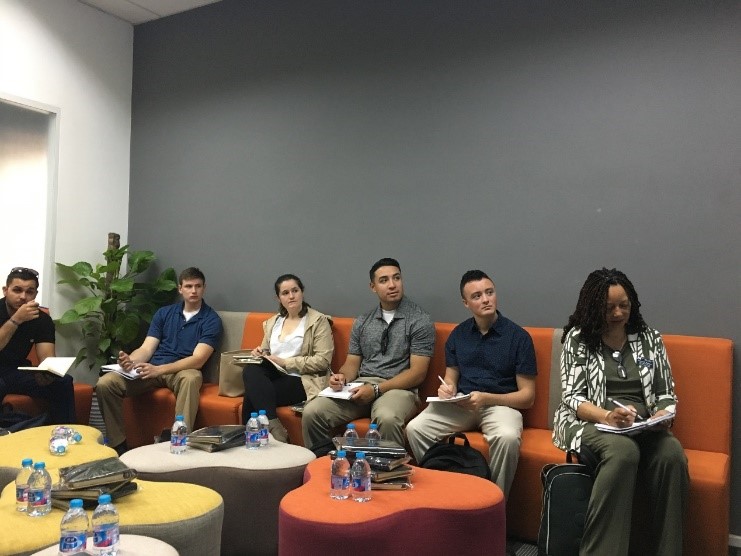
SUNY Maritime College Group Visit to oTMS

所属行业
客户规模
核心需求

Tuesday May 23rd oTMS welcomed the college students from SUNY Maritime College, who were visiting Asia to learn both professional knowledge and practical operation on International Transportation and Trade in Asia market.

As one of the innovators in the logistics field, oTMS provides the leading Cloud-Computing Transport Management System in China. With a core product named One-TMS, which base of a SaaS platform, an integrated mobile platform of a driver APP as well as a consignee APP, and a Business Intelligence toolkit that offers customized dashboards and reports, oTMS seamlessly connects everyone from shippers to 3PLs to vendors to drivers and consignees in the entire logistics ecosystem. In addition to One-TMS, oTMS is committed to creating a new Transport Ecosystem through the consolidation of five other products dedicated in Fintech, Transaction and Transport Control Tower.

After a warm welcome, the SaaS Senior Vice President, Mr. Zhiqi Zhang, gave the group a presentation on oTMS’s history, culture, idea, and how business operates at oTMS now. Students said that the speech from Mr. Zhang was informative, with sharp perspective, and very detailed in explaining the company’s business structure.

During Q&A session, Mr. Zhang helped the group on a lot of questions raised by both faculty and students, which made the group have a deeper understanding of how the business is running in China’s market.

Innovations, intelligent designs, and better user experiences make oTMS be one of the leaders in this industry. And the team is always willing to share their experience with all different communities. “The visit to oTMS adds a lot of value to their Asia visit. We hope all goes well for oTMS in the future.” Said SUNY students. Here we sincerely wish the college students from SUNY Maritime College success in logistics in the near future.

KPIs: In Life & Transportation Management

所属行业
客户规模
核心需求

Four Steps to Establish KPIs for Your Supply Chain

Introduction: KPIs, metrics, goals, deliverables – no matter what you call them we are all given some version of them for our jobs. We set KPIs as a way to monitor and measure performance. It’s a practice with an almost 100% adoption rate and has proven a successful way to ensure goals are set and achieved. If the deliverables are not met then it can be an indicator that changes may need to be made. 

Establishing KPIs and creating action plans to achieve the KPI targets is a no-brainer for transportation management and the same should be applied to one’s life. What are your “life KPIs” and how are you measuring your own personal performance? “Where do you see yourself in five years?” is a common interview question, but if you don’t have KPIs in place how do you really know if you’ve achieved what you set out to achieve year-over-year? To truly measure performance in life or transportation management you first need to establish KPIs. For today though, let’s tackle the latter and the importance of setting KPIs to manage your supply chain. 

I. The Right KPIs 

If the first step is understanding that KPIs are needed to help an organization monitor and measure their supply chain performance, then the next step is to identify  the right KPIs for your businessTo assist in doing this there are many resources out there from advisory and consulting firms like Gartner , but the organization themselves should know their own business the best and must determine what the right KPIs are for them.  

Ideally, they will start by collecting feedback and data from key stakeholders of each department in the company, not just logistics. The departmental silos must be removed within an organization as transportation effects every part of the business and insight from the different groups can be invaluable to ensure the right KPIs are set. If the wrong KPIs are used to monitor and measure the performance of a business the effects could be as detrimental or worse than not having any KPIs at all. 


II. The Right Data Source 

Once the right KPIs have been established then it must be decided what data source will be used to calculate each KPIs performance. Many company’s try to use an ERP or WMS or even *gasp* Excel as the data source, but the most efficient way to collect and collate data for true transportation management is by leveraging a transportation management system (TMS). The best TMS’ will provide business intelligence that includes dashboards and scorecards that allow a shipper to make quick and confident decisions as they aim to manage a data-driven and connected supply chain. 


III. The Right Targets & Prioritization 

Once the right KPIs have been established and the data source determined then targets for each KPI must be set and the KPIs prioritized. Historical performance or industry benchmarks are common ways an organization can set their KPI targets, but that should not be the end-all-be-all. Every company, every business is different, which means their KPIs and those targets may need to be different as well.  

Again, key stakeholders from different departments should be part of this discussion in not only identifying what the right KPIs are, but also in setting the targets. Prioritization of the KPIs is essential as well as it is expected that there will be conflicting interests between the stakeholders. For example, for on-time delivery, customer service may require that the target be 95%, but to achieve this it will increase the transportation costs by 8%. An organization must understand their business and prioritize their KPIs to find the right balance. 


IV. The Right Review 

Whether it be in life or transportation management, having the right KPIs will help to ensure success, although that alone will not guarantee it. Every task, project, etc. a person does in life or a company does in managing their supply chain must be aligned with and have an impact on the KPIs that have been identified as the best way to monitor and measure performance. If they do not, then questions must be asked such as why are we working on this project? Or if truly the right actions are being taken, but they don’t have an impact on the established KPIs then the question must be asked, do we have the right KPIs? This continual review will help keep all of the stakeholders aligned and moving in-sync toward achieving the KPI targets. 


Conclusion: KPIs, in life & transportation management, are a part of what my own father always tells me, “Plan your work, work your plan.” If you can’t measure it, you can’t improve it; using these four steps as a guide to help in identifying, defining, and setting targets for your KPIs in your life or managing your supply chain will allow for continuous improvement, but now the real work begins – working your plan. 

Author

Adam DavisVP of Managed Services in oTMS, responsible for SaaS TMS, transportation process control and consulting services, with 16 years senior management experience. General Manager of TMC Asia Pacific in C.H. Robinson since 2010.

GARTNER LISTS oTMS AS A “NOTABLE VENDORS” IN MAGIC QUADRANT REPORT FOR TRANSPORTATION MANAGEMENT SYSTEMS

所属行业
客户规模
核心需求

oTMS AS THE ONLY CHINESE VENDOR COVERED IN MAGIC QUADRANT REPORT

SHANGHAI, CHINA – MAY 2, 2017: oTMS, a leader in clouding and connected SaaS transport management system in China, today announced that Gartner, Inc., the world’s leading information technology research and advisory company, has listed oTMS as a “notable vendors” in its 2017 Magic Quadrant for Transportation Management Systems* report. oTMS is the first and the only China-based company covered in this Gartner research.

“We are excited to be the first China-based TMS vendor included in Gartner report and have them recognize that highest growth will come from Asia. This is what we experience, as Chinese market and customers are maturing and no longer accept manual processes” said Mirek Dabrowski, oTMS, CEO and co-founder.

According to Gartner, “The overall market size for supply chain execution (SCE) applications is estimated to have grown at an annual rate of 13% to $3.9 billion during 2016. Within SCE, transportation management systems is estimated to have generated 30% of the market spend.

Factors such as the need to reduce costs, and improve productivity, efficiency and customer service are driving the growth of the market through 2021. The Americas region is expected to continue to lead the global TMS market, followed by EMEA, with the APAC region expected to have the largest growth.”

“Traditionally, the implementation of a TMS solution was a long and complex project. Shippers’ and 3PL providers’ expectations around the implementation have changed dramatically, especially with the advent of multitenant cloud TMS options. Customers now require these solutions to be implemented in a much shorter time frame (weeks instead of months), at a much lower cost and provide a much faster ROI. Over the past year, Gartner has witnessed more and more implementations that were accomplished in six to eight weeks. Traditionally, these would have taken six months or more.”


*Gartner “Magic Quadrant for Transportation Management Systems” by Bart De Muynck. March 9, 2017.

About the Magic Quadrant

Gartner does not endorse any vendor, product or service depicted in its research publications, and does not advise technology users to select only those vendors with the highest ratings or other designation. Gartner research publications consist of the opinions of Gartner’s research organization and should not be construed as statements of fact. Gartner disclaims all warranties, expressed or implied, with respect to this research, including any warranties of merchantability or fitness for a particular purpose.

About oTMS

oTMS is committed to creating a new Transport Ecosystem and Making Transport Easy. In 2013, oTMS launched the first ever SaaS TMS + market place model in the domestic market. Today, oTMS not only operates a omni-channel SaaS TMS (One-TMS) with the largest market share in China, we have also, through the consolidation of five other products including oSuper, E-RFQ, One-Insurance, EasyLoan, and Transport Control Tower, achieved the establishment of a connected, digitalized and data-driven Transport Ecosystem. oTMS believes that, in the process of promoting industry development and transformation, every link and company along its industry chain can be further integrated for the creation of a better world that is more convenient, efficient, and green. For more information: www.otms.com