Former C.H. Robinson TMC APAC GM Joins oTMS oTMS Accelerates Evolution to Ecosystem

所属行业
客户规模
核心需求

Adam Davis, former General Manager of C.H. Robinson TMC (APAC), announced on January 6, 2017 that he would join oTMS, which will celebrate its fourth anniversary this year. Adam will be the VP of Managed Services in oTMS, overseeing its Managed Services which consists of three parts: SaaS TMS, Transportation Process Management and Consulting Services. Different from the traditional forms of transportation outsourcing, Managed Services is a type of management outsourcing based on TMS that helps clients maximize the value of SaaS TMS, implement Process Management, and continuously improve the transportation performance with professional tools and Data Mining. In this area, TMC, as the core department of CH Robinson serving its key accounts, is one of the leaders in the world.

As for the scope of Managed Services, clients are responsible for carrier selection, price negotiation, and contract signing, while outsourcing the management of the whole transportation process to TMS. This includes order creation, data cleansing/verification, order assignment, in-transit tracking, exception management, and bill reconciliation.

Adam joined C.H. Robinson in 2000, and had held various management positions for 16 years in different functions; involving Business Development, Operational Management, and Strategic Accounts Management. Since August 2010, Adam had been the General Manager of TMC Asia Pacific, of which 5 of those years were spent in Shanghai where he was responsible for the business development and accounts management in APAC, and aligning TMC’s Global Service with management of C.H. Robinson’s North America, Europe and South America divisions.

Based on the 16-year experience in C.H. Robinson, Adam believes: “As the middle class continues to grow in China and throughout Asia their demand for goods will increase at an exponential rate. This will challenge companies to be more efficient in all aspects of their business in order to stay relevant in a hyper-competitive market place, and especially so within their supply chains. A best practice that the best-in-class companies are leveraging is the implementation of a TMS. The implementation of a TMS allows a shipper to execute their transportation processes with greater automation and efficiency, which results in increased hard and soft savings. To take these savings to the next level many shippers are procuring managed services from a third-party to execute their transportation processes, which allows them to have an increased core focus on their business. For many companies implementing a TMS plus managed services is the ideal solution to achieve their supply chain goals and to ensure their network is optimized and as efficient as possible.”

When commenting on his decision to join oTMS, instead of seeking other opportunities, Adam said: “As the demand for TMS solutions continues to grow in China, oTMS has quickly become a market leader since their inception in 2011 and I am very excited to join their leadership team. The entrepreneurial culture led by Mirek and David with a focus on the customer and creating a best-in-class product is what really attracted me to oTMS. The great growth of the company over the past five years has been very impressive and I look forward to working with the rest of the leadership team to continue this trend.”

The joining of Adam is an important step for oTMS in improving its new ecosystem. Several days ago, oTMS announced launching its first product in Managed Services – Transport Control Tower which follows closely recent product launches like oSuper, RFQ platform, Insurance, and Finance. This Managed Services product focuses on maximizing the clients’ benefits for internal use, while helping them strengthen the process control, and using all kinds of data to machieve continuous optimization.

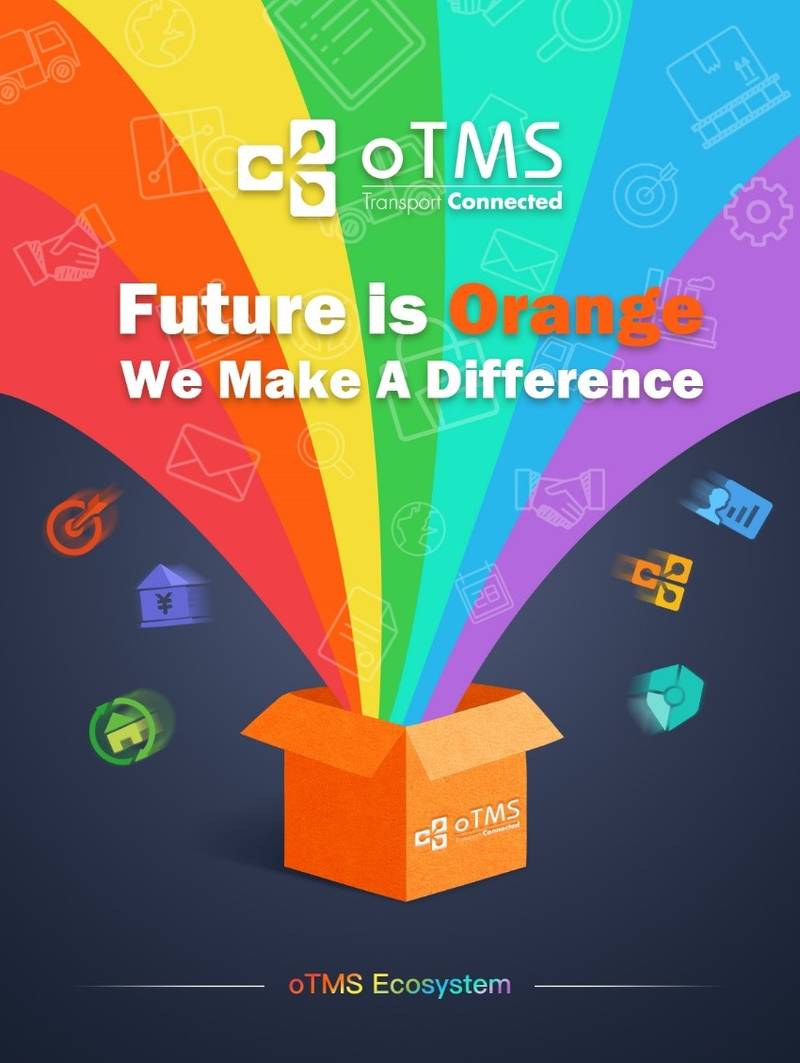
So far, all the products for oTMS’ new ecosystem have all been unveiled:

1.Omni-Channel TMS

2.oSuper: the logistic solution for Municipal Commercial Circle, to connect the seller in the upstream and to empower the courier/o2o distributor in the downstream

3.E-RFQ: the online bidding platform, offering better experience in powerful bidding tools, high quality resources, and in-depth intuitive data tools

4.Insurance: insurance for the whole process of the transportation, to offer an guarantee for different stakeholder in this supply train, and say bye-bye to duplicate insurance

5.Finance: quick loans for maximizing the value of corporate data, enabling digital credit and stabilizing the clients’ capital chain

6.Transportation Control Tower: Business Process Outsourcing
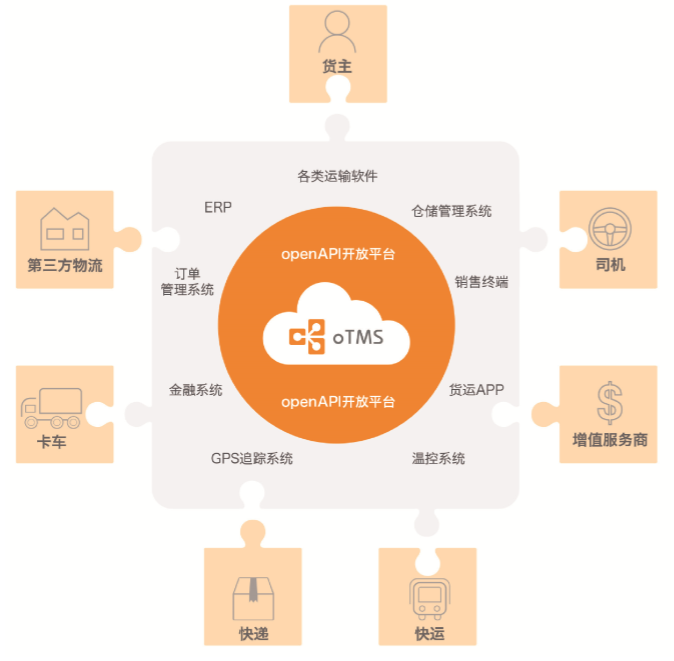
Moreover, while these products can work together as a whole to bring synergy, they can also be used independently and connected to each other later on. For Example, BESTSELLER (绫致时装), LiNing, and Toredo have been longtime users of Otms before onboarding oSuper, while Balabala adopted oSuper first before moving to SaaS TMS fulltime. Likewise, YIHAI KERRY (益海嘉里) and Whaley (微鲸电视) were powerusers of oTMS SaaS before opting for RFQ platform, while Goodbaby implements RFQ platform first and then connected to SaaS TMS.  This phenomenon is more typical in insurance products, as we can see that the value of policy for merchandise from contracted enterprises, has exceed 5 billion RMB just in a few weeks after its launch, and most of these enterprises are user of SaaS TMS.

This forms a continuously improving ecosystem for oTMS, just like a well-managed shopping center which offers diverse features to attract consumers; including restaurants, fashion retailers, toys stores, bookshops and etc. In turn, these various shoppers come together and become connected and synergized.
oTMS and JDA Collaborate to Help Customers Achieve a Seamless Supply Chain

所属行业
客户规模
核心需求

October 9, 2016 —— The one-stop transportation service platform, oTMS, and JDA, the leading provider of end-to-end, integrated retail, omni-channel and supply chain planning and execution solutions, have announced a collaboration to integrate the oTMS solution within the JDA Transportation Management platform to enable customers to achieve end-to-end supply chain visibility.

Currently, transportation challenges are unprecedented in the transformation journey to Internet+ by brick-and-mortar retailers, manufacturers and logistics providers. The traditional single B2B channel has evolved into the current complicated and flat coexistence of multiple channels, such as B2C and O2O. The fragmentation of transportation orders means increased pressure for efficiency and cost management, which requires not only efficient management tools, but also a resources platform for the visibility of transportation processes and integration and alignment with the whole supply chain.

oTMS’ SaaS solution platform will integrate with JDA Transportation Planner, JDA Transportation Modeler, and JDA Transportation Manager to enable cutting-edge advantages at both the planning and operational level for better transportation visibility and performance.

“This collaboration will drive seamless integration of customers’ internal SCM system and external transportation management system,” commented Duan Yan, co-founder and COO of oTMS, “This is a big step toward a true one-stop, end-to-end supply chain management. JDA and oTMS will work together to promote innovations in enterprise supply chain management, focus on achieving real and comprehensive results in the supply chain management, and help our customers become more adaptable to the requirements of this ‘Internet+’ age.”

Having distinct Internet+ genes, oTMS’s biggest strength is connecting the whole chain of internal logistics and external transportation and achieving coordinated management. oTMS uses “SaaS+ Mobile App” to connect each stakeholder in the transportation chain and then establish vertical and horizontal coordination. oTMS’s omni-channel transportation management solutions have been widely used by more than 400 customers in retail, consumer goods and pharmaceutical industries.  JDA offers end-to-end solutions from supply chain planning, retail planning, store operations, category management, to transportation and warehouse management for manufacturers, retailers, and 3PLs.  

“In the age of Internet+, the time is now for Chinese companies to transform their logistics and transportation processes. JDA and oTMS collectively understand the Chinese market’s  logistics trends and challenges and the importance of omni-channel ,” said Amit Bagga, Regional Vice President of APAC, JDA, “This collaboration with oTMS will leverage our robust transportation management solutions which complement oTMS’s strengths in transportation execution, thus achieving the full spectrum of seamless management from front-end planning optimization to back-end execution track & trace, and improving the overall supply chain performance and value for the customers.”

Harnessing tech for better transport

所属行业
客户规模
核心需求

In this “information age”, where instant messaging and the use of sophisticated software tomanage data is becoming increasingly important, it is hard to imagine an industry worth 5.4trillion yuan ($871 billion) using e-mails to communicate and relying on Excel spreadsheets tostore information.

But the reality is that some of China’s largest business-to-business transportation industryfirms are still not making use of technology advances, resulting in higher costs and lowerefficiency, especially compared with similar companies operating in the United States andEurope.

It is this lacunae that has provided an opportunity for Poland-born Mirek Dabrowski to start hisown transportation software enterprise in Shanghai and shake the industry with a newconcept.

Dabrowski founded oTMS in 2013 after having spent 13 years working in China as a regionalmanager for several international transportation and logistics companies, including Denmark’sDSV A/S and Germany’s DHL Express.

Although he has no experience in software development, it was clear to him that the B2Btransportation industry in China needs a technological revolution.

“The idea of creating the software was driven by all the frustrations I suffered while working inthe industry. Especially in terms of how inefficient the system was and how slowly informationtraveled to the different parties involved in the supply chain,” said Dabrowski, the founder ofoTMS.

The software developed by his company uses the technologies of cloud computing andmobile Internet to connect every party in the transportation process, including shippers,trucking companies and drivers.

The service provides real time information, monitors unusual conditions and simplifies routinework.

While the concept might appear simple, the idea has actually helped transportationcompanies save time and money.

“We created a product specifically for the characteristics and the realities of the Chinesemarket. The B2B transportation industry in China is still very fragmented and it is in a veryrudimentary stage,” said Dabrowski.

He said that China’s largest B2B transportation companies currently do not even usespecialized computer programs to monitor their deliveries. This translates into higherexpenditures and lower efficiency.

“We help companies to save costs, especially those related to administration procedures. Togive an example, before using our system it could take companies around 30 days to collect aproof of delivery. But now they can do it digitally with a mobile phone in a matter of seconds,”Dabrowski said.

Although he first imagined the concept in 2000, the lower Internet penetration and theabsence of smartphones did not allow for real improvements in the industry.

He said that back in 2000 his idea was just a vision, because it was not technologicallyfeasible.

But in 2011, all the components needed such as cloud technology, smartphones and mobileapplications were already there.

It was not until 2013 when the company went live with the product, that it gained its firstcustomers and received funding to grow the business.

“Back in 2013, not many people understood our concept and what we wanted to do. The mostcritical moment for us was to obtain the first round of investment. After that everything goteasier,” he said.

Last year, the company received its second round of investment of $6 million from searchengine giant Baidu Inc and private equity firms Matrix Partners and Buttonwood Capital.

“The reason we chose Baidu as an investor was because of its strong brand. Also, it wasimportant that they shared our vision and that they wanted to invest in companies that usedata to improve traditional industries”.

A hundred individual users and more than 120 companies in China are currently using oTMS.

The company’s largest customer is Danish retailer Bestseller A/S, owner of the Jack & Jones,Vero Moda and Only brands.

Dabrowski said that there is an obsession in China to improve efficiency in the B2Ctransportation industry due to the enormous success of e-commerce. But improvements in theB2B transportation industry have been neglected.

“The B2B transportation industry in China is a 5.4 trillion yuan market, while the expresstransportation industry is under 1 trillion yuan, even as the e-commerce sector is growingextremely fast. This is because despite the growth registered by the express industry, theystill partly rely on B2B to operate.”

He said that the radical transformation undergone by the B2C transportation industry in Chinaindicates that a similar transition needed to be carried out in the B2B sector.

oTMS took the mechanism that had been implemented by express delivery companies andadapted them. The company believes that the imbalance between B2B and B2C shows thatthere is a very interesting market to develop in China.